
In the process of upgrading my machine i wanted to upgrade some stepper motors.
But after the Y axis upgrade i ran out of space inside the controller enclosure.
So its a great excuse for a new CNC Controller, with bigger drivers and stuff like that.
I have received a lot of questions about the electronics.
And also there are a lot of people who are afraid to build the controller.
There for i will try to explain the build step by step, if it only helps one of you the effort was worth it..
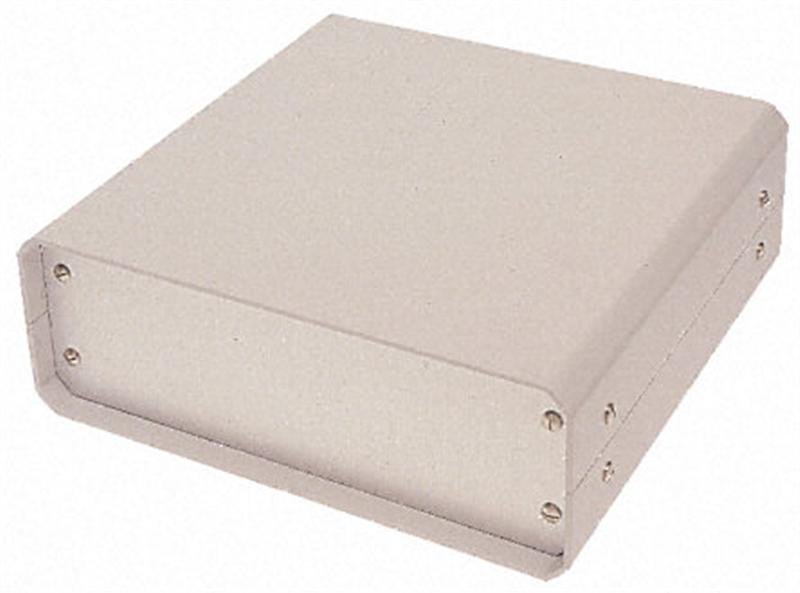
First of all i needed a new controller enclosure, these universal enclosures aren’t cheap but well…
I found a suiteble one at https://www.rs-online.com/ part number :818-637
The external size is approx l=367mm w=300mm h=134mm.
The CNC Controller is the ‘thing’ that connects the PC to the CNC Machine.
The PC in my case will have the control software Mach3 running on it.
This software sends pulses t0 the LPT / Parallel Port (DB25) and receives info back through this same port.
The signals from this port will go to the stepper drivers, and these will drive the stepper motors.
You could just connect the wires from the DB25 to the drivers.
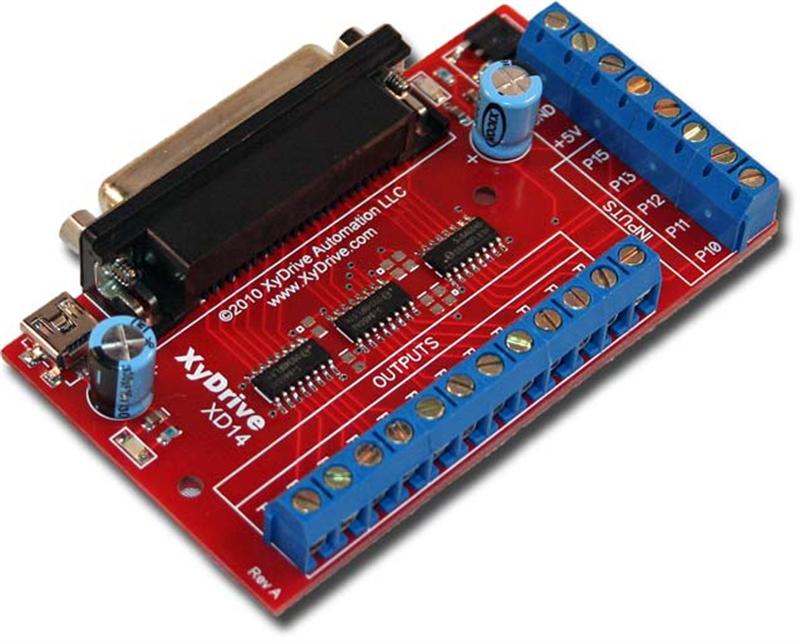
But a better way to do this is to use a BOB (BreakOut board).
A BOB is used to interface the PC to the outside world.
All In/Outputs are terminated in a screw terminal which provides easy wire connections.
On the better breakout boards the incoming side is isolated from the outgoing side.
This is to protect the PC from potentially damaging current and voltage spikes (from the motors).
A lot of these boards are Opto-isolated, but the newer version i use uses radio waves.
The great advantage of this radio wave type is a much higher signal speed (1MHz),
and it operates from a signal as low as 2,7V where most opto boards need 5V.
Is this a advantage? Yes…, because a lot of new PC’s operate with a 3,3V parallel port signal.
The XD14 breakout board : [datasheet]
The signals that come out of the breakout board go to the various features in the controller.
The main thing would be the stepper drivers because the drive the stepper motors.
Mach3 sends an ‘Enable’ signal to enable the motor to turn,
and it sends a STEP and DIR signal to tell the motor to turn 1 STEP in a DIRection.
So this Step en Dir signal need to be translated in actual movement of the stepper motors.
For this we need stepper drivers, and there are a hole lot of those in the market.
So what stepper drivers do you need? wel that depends on the motors you buy.
For example my Y stepper is from a 8-lead type, so i need a 2 phase driver.
The motors are rated 4.2Amp if i connect is in bi-polair parallel (more about the steppers later on).
I want a smooth running machine so i want the drivers to have micro-stepping.
So i need a 2phase microstepping driver with a minimum of 4,2Amp output capability.
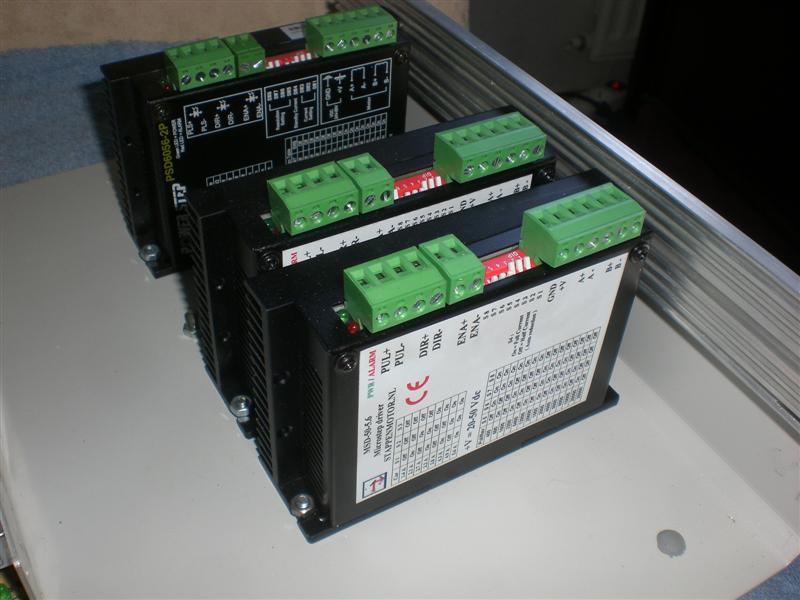
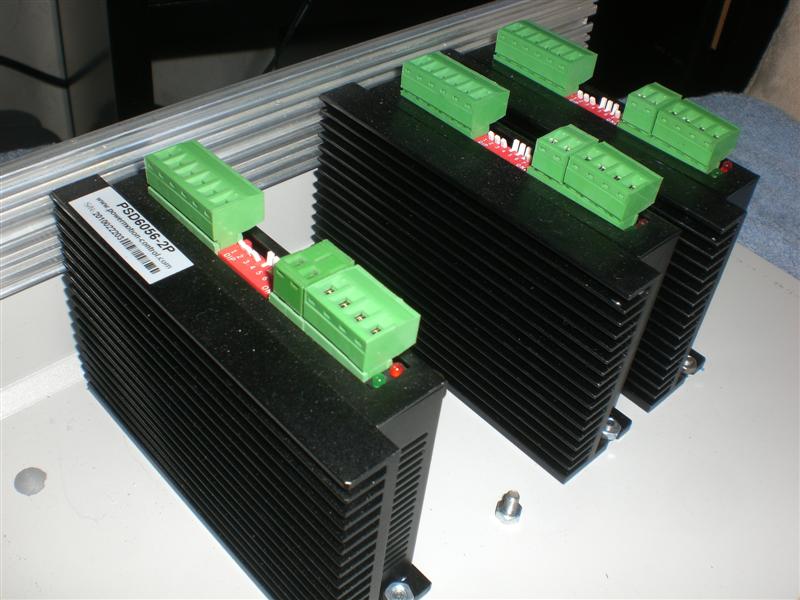
On ebay you will find them under names like MD556 and on stappenmotor.nl on MSD-50.5.6.
The microstepping drivers can divide 1 motor revolution in25000 steps if you want to.
This will give very smooth results, although speed of the motor will go down.
These drivers can take up to 50V and drive motors till 5,6Amp [peak].
(Note : As i have collected my parts over time i use 2 different brands)
(On the picture you see 3 drives, but there will be 4 in there eventually)
[MD556 Datasheet] [MSD-50-5.6]
Will the motors turn right now? no they still need some sort of power supply.
In my RoboElectronics X1 controller i used a transformer, ac-dc converter and some big elco’s.
This time i will use a switching power supply to reduce space inside the controller.
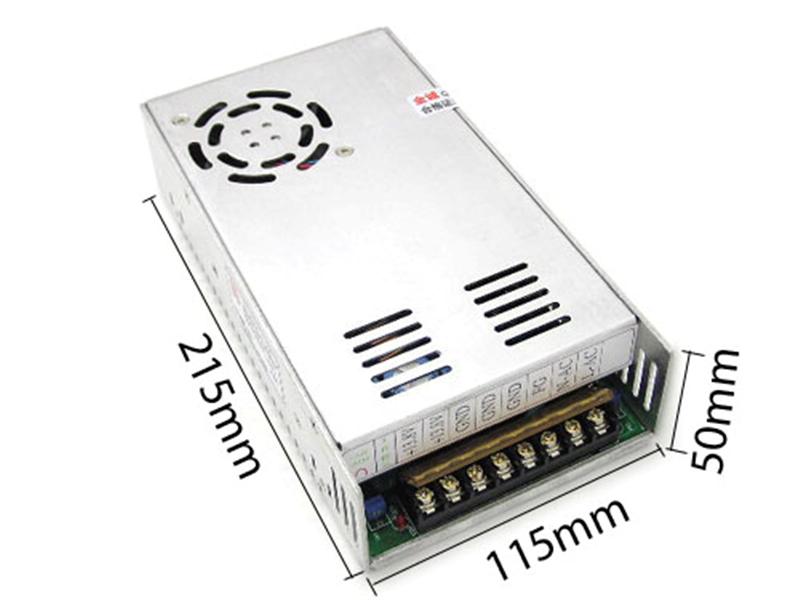
The power supply i will be using is a 500W 48V switching power-supply.
The 48V should be ok as its beneath the 50V maximum of the drivers…
The 500W results in a output of max 10,4Amp.
In the next posts you will see that the motors to getter should use more than this.
But although i can not help with the math, this should work fine because :
a: the motors will never ask full maximum current all at the same time.
b: I use micro-stepping (PWM signal) therefor the input should be lower on the drivers.
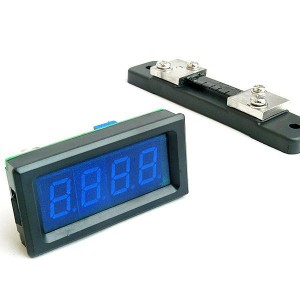
Since i really wonder what current there will flow i will use a digital panel meter [datasheet].
This part is just a extra and is really not needed to build the controller.
The panel meter uses a shunt resistor to measure the output current of the supply.
Thats it for part 1, to be continued…